NASA Space Apps Challenge 2026 · Space Mission Design Game
Andes to Orbit

A free game where one to four players design a complete space mission, negotiate it as a team, launch it, fly it, and learn why it worked or failed.

Team
Paulet Delta-V
Members
—
Challenge
Space Mission Design Game
Local event
Trujillo, Peru
01 / 07
The hook

In the 1890s, the Peruvian engineer Pedro Paulet claimed he fired a liquid-fuel rocket engine in Paris, decades before anyone else.

What would it take to finish today what he started?

The gap

Students rarely get to design a whole mission, from the goal to the last day of operations.

The trade-offs

Mass, power, data, budget, orbit and launcher stay abstract when you learn them one at a time.

Our answer

A game where every choice moves at least two resources, and there is never one right design.

PAULƎT · ANDES TO ORBIT
02 / 07
The player's experience · 10 minutes

Design. Launch. Fly. Read the letter.
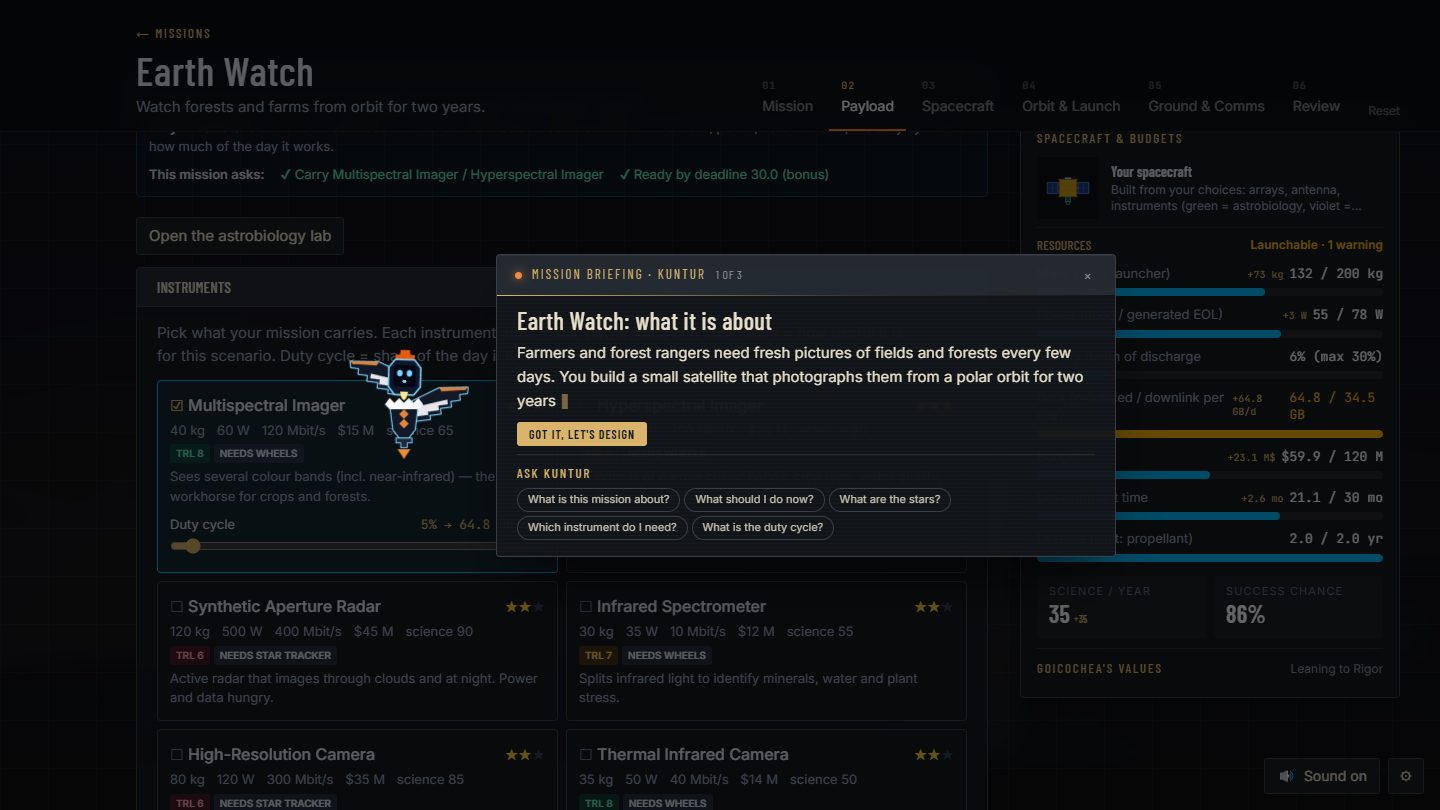
Payload tab with instruments and the live resource dashboard
1 · Design

Pick instruments, power, orbit and launcher. A live dashboard shows mass, power, data and budget move with every click.
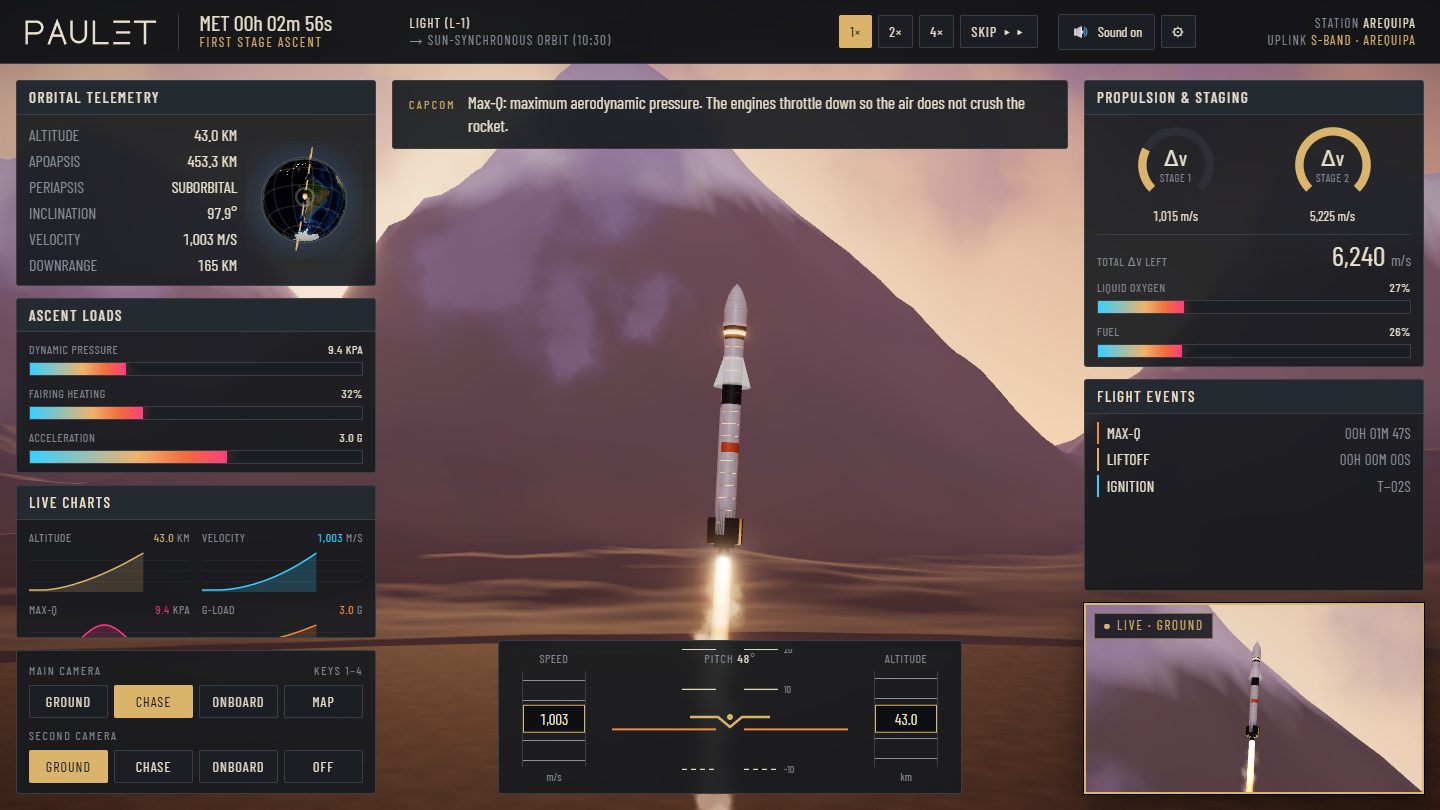
3D launch flight deck with telemetry
2 · Launch

A 3D flight deck with real telemetry for the chosen orbit and live cameras: ground, chase, onboard, map.
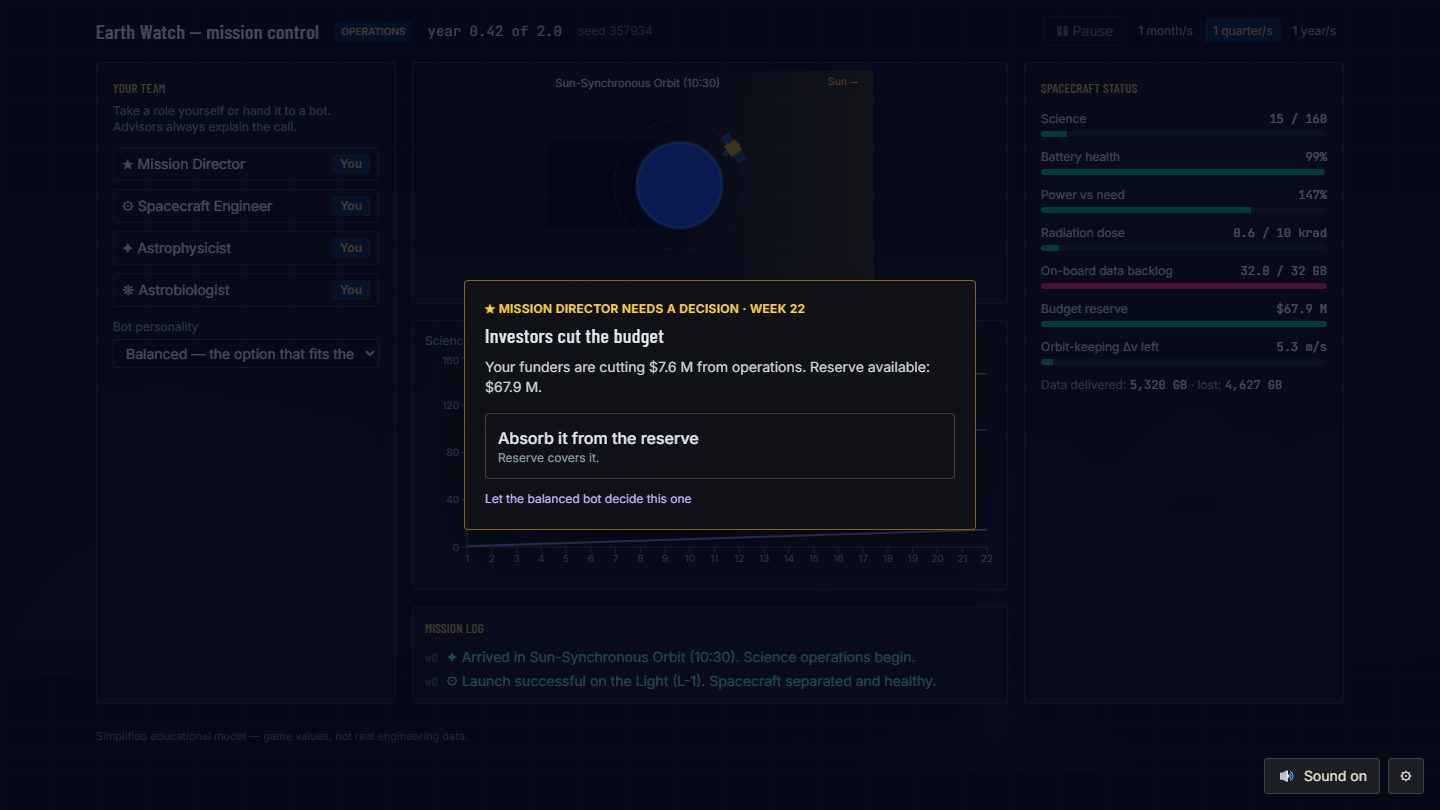
Mission operations with an investor event
3 · Fly

Years of operations in minutes. Solar flares, debris and budget cuts: the team decides, with advisors who explain.
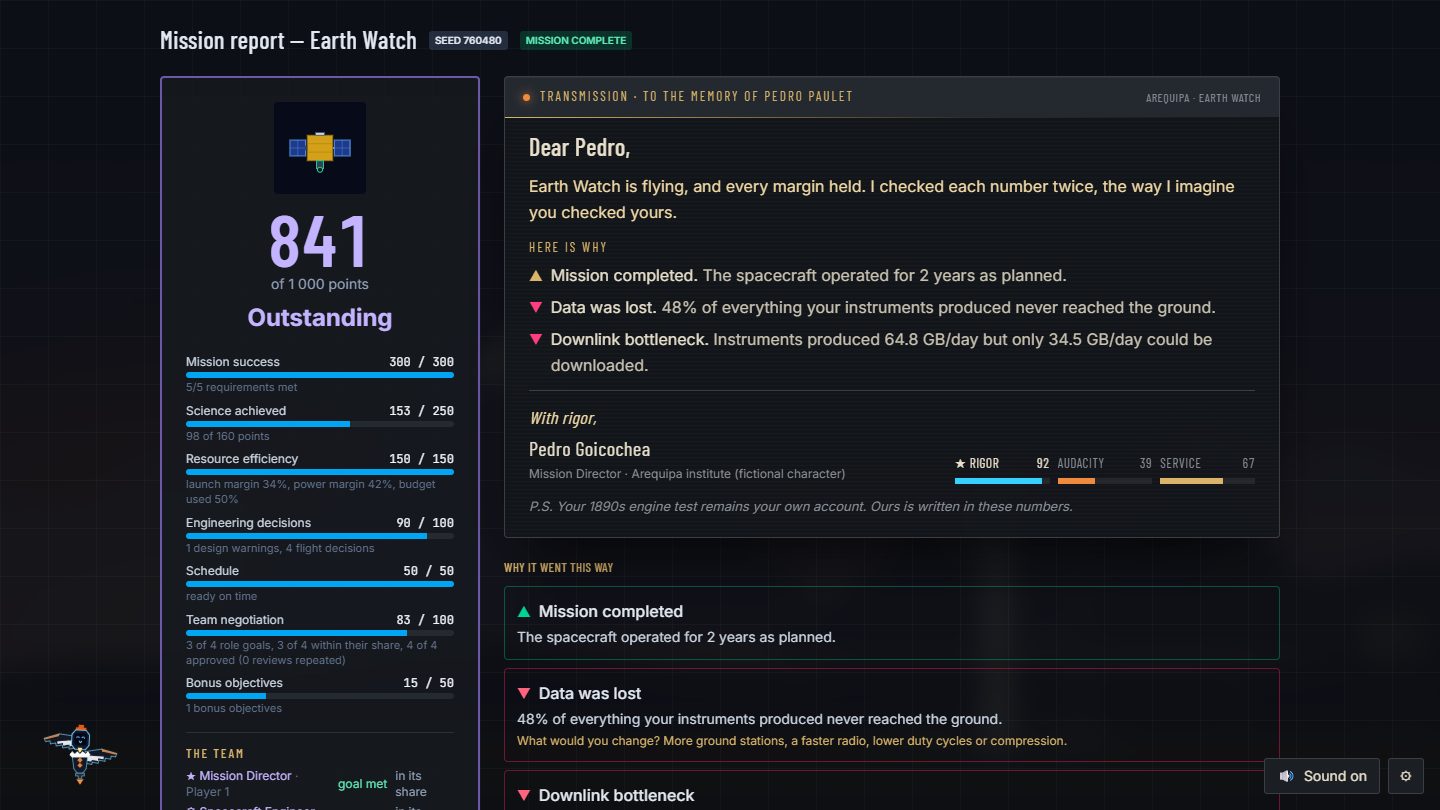
Mission report with the Letter to Paulet
4 · Learn why

A score out of 1,000 and a letter to Paulet that explains, in plain words, what worked, what failed and what to change.

The design review never says only "wrong": it says why, and what to change.

03 / 07
Collaboration · up to four players

A real mission team has to agree

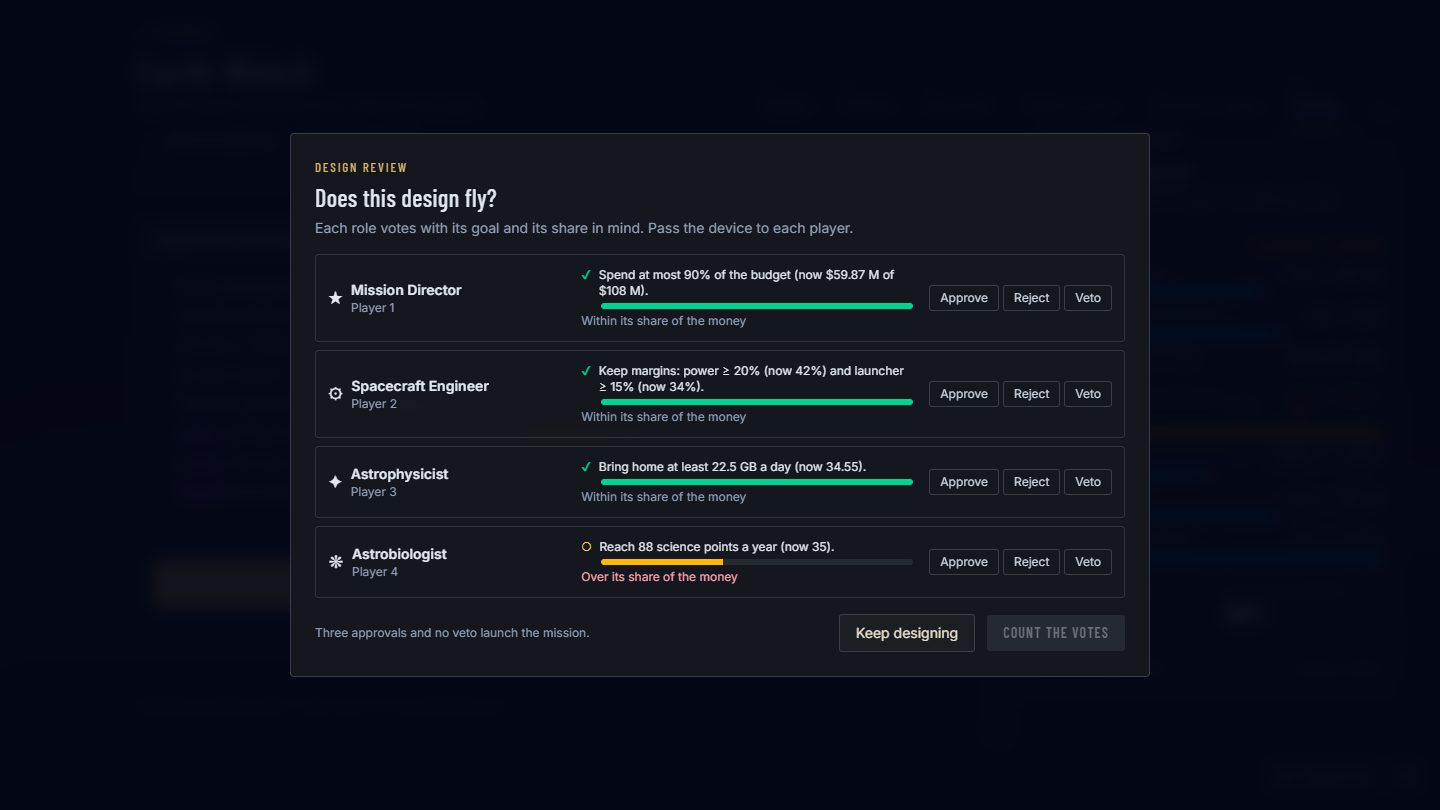
Design review: each role approves, rejects or vetoes the design

The money is split

Each role owns a share of the budget, set by what matters most in that mission.

Own goals, one group goal

The engineer wants margins, the scientists want data. The team scores only if the mission works.

Vote with veto

Three approvals and no veto launch the mission. One device, or an online room joined by link.

Goicochea · DirectorChicho · EngineerRoberto · AstrophysicistFranchesca · AstrobiologistKuntur · robot guide
04 / 07
NASA data and methods are the engine, not a credits page

Every number has a NASA source

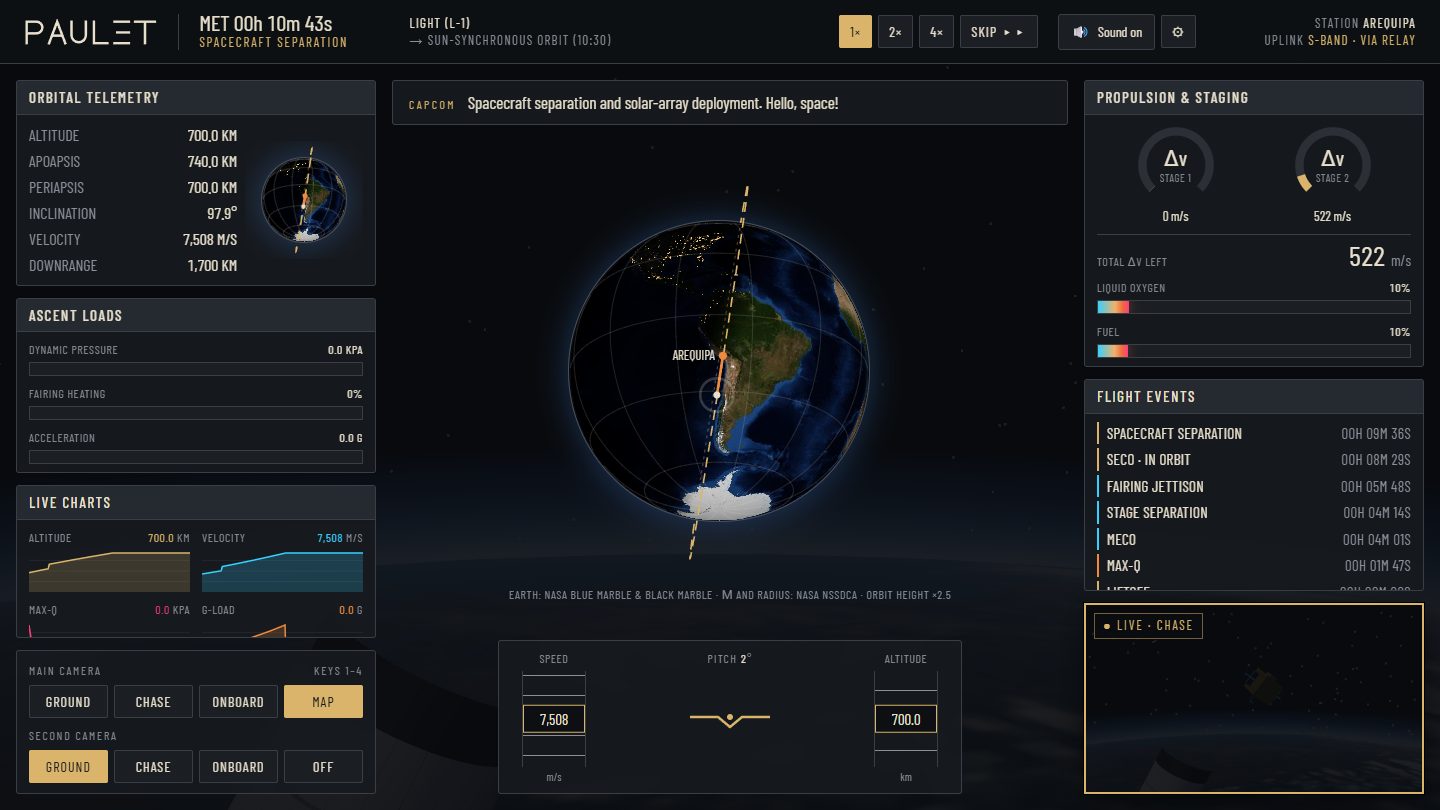
Flight deck map view: the ascent from Arequipa drawn over NASA Blue Marble imagery 1 2 3 4
  • 1Blue Marble & Black MarbleNASA Earth Observatory imagery of the real Earth, day and night, under the ascent route from Arequipa.
  • 2Orbits from NASA constantsEarth's GM and radius (NASA NSSDCA fact sheets) give orbital speed, period and eclipse.
  • 3Rocket equation and stagingFrom NASA Glenn's Beginner's Guide: Δv per stage, specific impulse, why stages drop.
  • 4How NASA designs missionsMission segments, JPL Concept Maturity Levels and the Mission Design Lab trade study, plus 19 cited sources in the in-game "NASA data" screen.
05 / 07
Impact

Built for classrooms with little connectivity

$0

Free, no account

Opens in any browser in one minute. A teacher shares one link.

Offline

After the first visit

The whole game installs itself, so it keeps working where the internet does not.

EN · ES

Bilingual

English and Spanish, for students in Latin America and beyond.

1–4

Solo or as a team

Kuntur, the robot condor, takes any empty seat and answers questions.

Seeded

Fair comparisons

Same mission, same events: a class can compare designs and challenge friends by link.

4 acts

From Arequipa to Mars

A sounding rocket, Earth orbit, the Moon's quiet points and Mars launch windows.

Next: a short animated story before each act, more languages, and a teacher view to compare a whole class.

06 / 07
Play it now

Finish the promise. Design your mission.

Made with AI assistance, disclosed on the project page: code with Claude (Anthropic), any illustration made with Google Gemini carries an "AI-generated" mark, music with ACE-Step run locally, voices and effects with ElevenLabs. No NASA logos are used. Pedro Paulet's engine tests are presented as his own claims. Dr. Goicochea and the team are fictional adults.

07 / 07